The Ghost Ships of the Indian Ocean: A Guide to Wreck Diving Sri Lanka
Forget the sunny reefs and colorful coral gardens. In the silent, shadowed depths of the Indian Ocean surrounding Sri Lanka, a different kind of treasure awaits. Here lie the ghost ships—colossal steel monuments of warfare, commerce, and tragedy, now transformed into some of the most spectacular artificial reefs on the planet.
For the advanced diver, these wrecks are not just dives; they are time capsules. They offer an immersive encounter with history and a level of technical challenge that recreation reef diving simply cannot match. If you are ready to push your boundaries and explore the sunken giants of the deep, Sri Lanka is your ultimate destination.
Deep History: Exploring Sri Lanka’s Wreck Elite
Sri Lanka’s strategic position on ancient and modern trade routes, combined with intense naval conflict during World War II, has created a seabed littered with world-class wrecks. Let’s explore two of the titans that define this region.
1. The HMS Hermes: The World’s First Carrier (Batticaloa)
Resting off the East Coast, the HMS Hermes is perhaps the most famous wreck in Sri Lanka, if not the entire Indian Ocean. Sunk by Japanese aerial attacks on April 9, 1942, this mighty vessel was the first ship in history designed and built specifically as an aircraft carrier.
The History: She served with distinction before meeting her fate alongside her escort, the Australian destroyer HMAS Vampire. Over 300 crew members were lost in the rapid, overwhelming assault.
The Technical Challenge: This is strictly Technical Diving territory. The Hermes lies on her port side at a maximum depth of 53 meters (174 feet). Exploring her requires Trimix, twin sets, and rigorous decompression protocols.
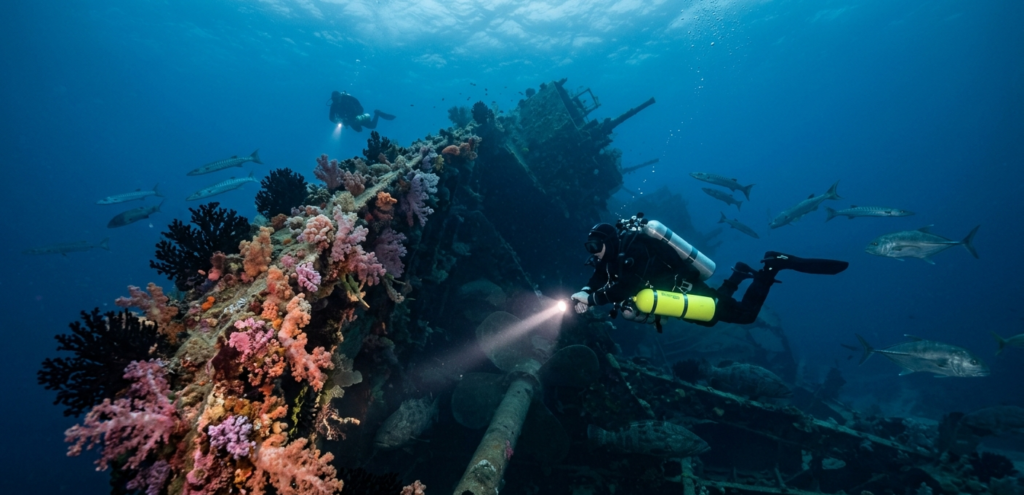
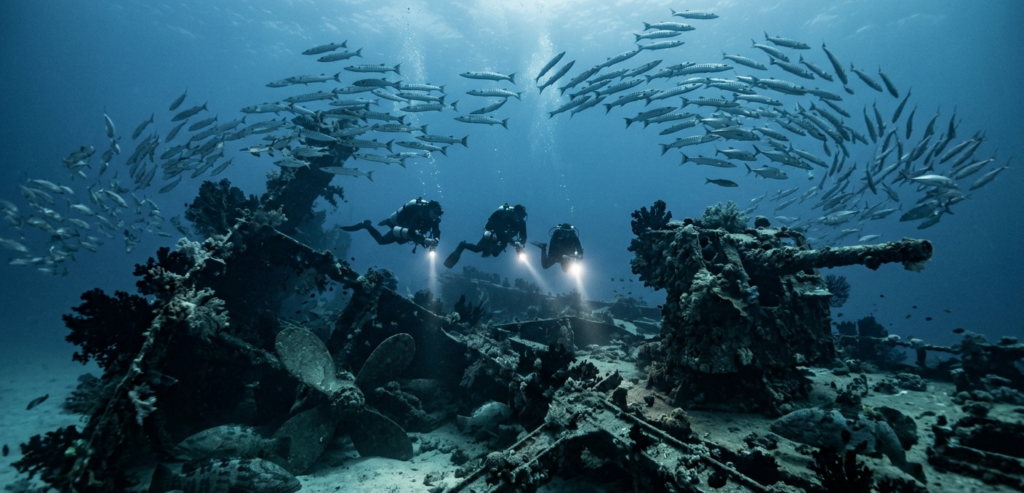
The Artificial Reef: Despite her fiery end, the Hermes is now a cathedral of life. Her massive hull is enveloped in stunning pink and purple soft corals and black coral bushes. It is a magnet for giant potato groupers, colossal schools of barracuda, snapper, and Napoleon wrasse. Swimming past her anti-aircraft guns and immense propeller is a hauntingly beautiful experience.
2. The SS Conch: The World’s First Tanker (Hikkaduwa)
If the Hermes is the king of Eastern wrecks, the SS Conch rules the Southwest. Located just off Hikkaduwa, she holds the prestigious distinction of being the world’s first purpose-built steam tanker (1892). She foundered on Akurala Reef in June 1903.
The Wreckage: Unlike the intact Hermes, the SS Conch has broken apart, scattering boilers, engine machinery, and metal sheets across a wide area. This makes for a fascinating exploration site, like a maritime puzzle on the seabed.
The Diving Specs: A much more accessible dive than the Hermes, the Conch lies at a max depth of 21 meters (69 feet), making it a spectacular experience for advanced recreational divers and an excellent introduction to wreck penetration.
The Biodiversity: The complex metal structures provide perfect shelter. Divers can navigate swim-throughs and encounter large groupers, schools of trevally, batfish, and sometimes even resident nurse sharks and turtles. The artificial reef effect here is profound.
Bonus: Discovering the “Beer Wreck”
While the SS Conch is the major historical draw in the area, Hikkaduwa also offers the uniquely charming “Beer Wreck” (SS Orestes). This British cargo ship sank in 1875 while carrying a cargo of, you guessed it, bottled beer. While penetration is dangerous due to collapse, exploring the exterior at roughly 24 meters reveals the ghostly outlines of her cargo, embedded in the structure and surrounding sand, covered in marine growth.
Are You Ready to Face the Ghosts?
Wreck diving in Sri Lanka isn’t just about technical skill; it’s about preparation, respect for history, and having the right team. From the staggering depths of the Hermes to the intricate machinery of the Conch, these ghost ships offer experiences that stay with a diver forever.
If you are an advanced diver seeking the ultimate Indian Ocean challenge, or a technical diver looking to check a world-first off your list, your expedition starts now.
Start Planning Your Wreck Dive with Sri Lanka Diving Tours